
Updated November 17, 2026.
How to analyze policy documents without losing the evidence trail
To answer how to analyze policy documents: define the policy question, collect the full source set, extract claim-level evidence into a matrix, check each claim against its source, compare documents on the same criteria, record contradictions, then draft conclusions with citations attached to specific passages.
That is different from summarizing a report. Summarization tells you what a document says. Policy document analysis tests what it claims, what evidence it uses, who it affects, what it proposes, and where its definitions, assumptions, or conclusions diverge from other sources.
This workflow fits legislation, consultation papers, regulatory guidance, government reports, think-tank papers, stakeholder submissions, implementation plans, impact assessments, and related web sources. It is built for work where a loose “the policy says…” is not good enough.

Policy document analysis is a form of document analysis, a method widely used in health policy and other policy research because documents often contain the formal record of decisions, rationales, evidence, and institutional positions. Dalglish, Khalid, and McMahon describe document analysis as “one of the most commonly used and powerful methods in health policy research” in their open-access article on document analysis in health policy research.
The operational problem is not usually reading one document. It is keeping the evidence trail intact across many documents that use similar words to mean different things.
Define the policy question and boundaries before reading
Start with a question that can be answered by evidence, not a broad topic.
“Compare two housing policies” is too loose. A usable question looks more like:
Decision: Which proposal creates the more enforceable affordability obligation?
Population: Low-income renters, first-time buyers, social housing tenants, regulated firms, local authorities.
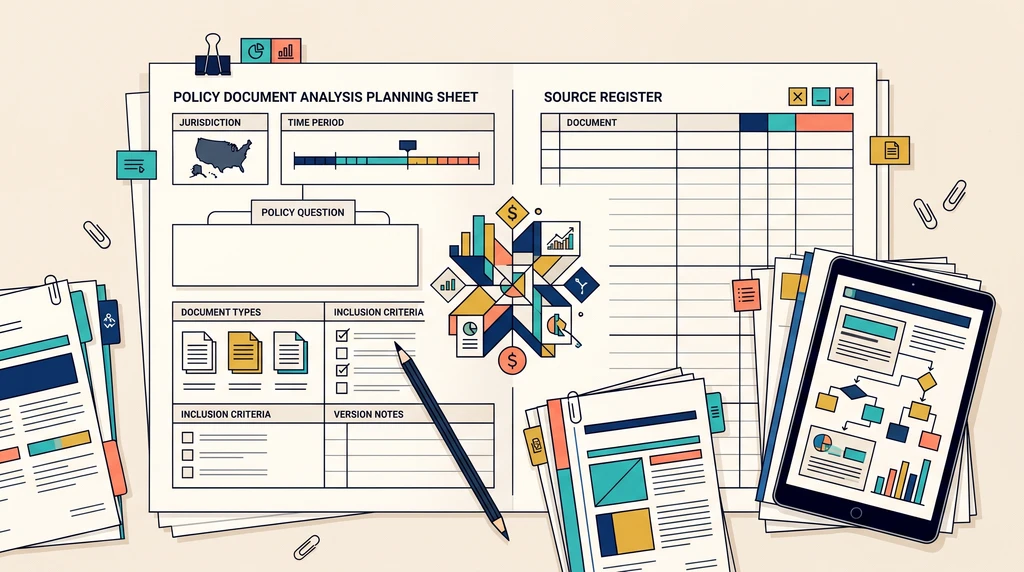
Jurisdiction: England, Scotland, California, EU member states, federal agencies, or a named municipality.
Time period: Current law, proposed reform period, implementation window, post-review period.
Policy instrument: Primary legislation, statutory guidance, funding condition, tax credit, licensing regime, procurement rule, enforcement notice.
This framing prevents one of the most common policy-analysis errors: comparing unlike materials as if they have the same status. A statute, a consultation paper, a ministerial speech, an agency FAQ, and an advocacy submission may all discuss the same policy, but they do different jobs.
Before collecting sources, write inclusion and exclusion rules. Label whether you are including:
Binding law or regulation.
Draft legislation or proposed rules.
Official guidance.
Impact assessments.
Consultation responses.
Evaluation reports.
Budget documents.
Stakeholder submissions.
Academic analysis.
Media or commentary.
Secondary analysis is useful for context and competing interpretations. It should not replace the underlying policy document when the question turns on what a rule, obligation, definition, or proposal actually says.
Create a source register as soon as you collect documents. For each source, record:
Title.
Issuing body.
Publication date.
Jurisdiction.
Document type.
Version, amendment, or withdrawal status.
URL or repository location.
Access date.
Notes on legal or policy status.
This register matters because policy documents change. Guidance is revised, consultations close, web pages disappear, datasets update, and statutes are amended. If the analysis will be reused later, the version record is part of the finding.
Read each policy document for structure before extracting claims
Do not begin by highlighting everything that sounds important. First map the document’s architecture.
Most policy documents have some version of these components:
Executive summary.
Problem definition.
Legal authority or institutional mandate.
Objectives.
Proposed actions.
Implementation mechanism.
Funding or resource assumptions.
Affected groups.
Monitoring or evaluation plan.
Definitions.
Exceptions and exemptions.
Appendices, technical annexes, and cited evidence.
This first pass tells you where the important claims are likely to sit. Definitions may be buried in an appendix. Enforcement provisions may appear after funding language. The strongest caveat may be in a technical annex, not the executive summary.
Record who produced the document and who commissioned it. An independent evaluation, a regulator’s guidance note, a departmental consultation, and a think-tank proposal may all look polished, but they carry different incentives and authority.
Then classify the document’s status:
Binding: law, regulation, formal licence condition, court order, binding agency rule.
Advisory: guidance, recommended practice, explanatory memorandum.
Proposed: draft bill, consultation paper, policy option paper.
Evaluative: audit, review, impact assessment, post-implementation evaluation.
Advocacy or promotional: campaign report, manifesto, industry submission, position paper.
During the skim, locate repeated terms, thresholds, dates, targets, exceptions, and cross-references. Search for words such as “must,” “may,” “shall,” “should,” “except,” “subject to,” “where applicable,” “review,” “monitor,” “funding,” “eligible,” and “compliance.”
Preserve exact locations. Use page numbers, section headings, paragraph IDs, table numbers, footnote numbers, stable URLs, and archive notes where needed. A policy analysis that cannot return to the passage is not yet analysis; it is a set of impressions.
For web pages and PDFs, a research workspace helps because the source trail often spans formats. Otio for policy research lets you keep PDFs, web pages, notes, chats, transcripts, and cited answers in one project space rather than splitting the record across a browser, a PDF reader, and a notes app.
Build a claim-and-evidence matrix for every document
Use one row per substantive claim. Do not use one row per document summary.
A policy document may contain dozens of claims: a claim about the size of a problem, a claim about causation, a claim about the expected effect of an intervention, a claim about costs, a claim about legal authority, and a claim about implementation capacity. Each one needs its own evidence trail.
A useful policy claim matrix includes:
Claim: The proposition being made, in your own words.
Exact passage: The quoted wording from the document.
Location: Page, section, paragraph, table, footnote, URL, or timestamp.
Document metadata: Title, authoring body, date, jurisdiction, version.
Claim type: Descriptive, causal, predictive, normative, legal, operational, or quantitative.
Supporting evidence: What the document cites or presents.
Cited source: Dataset, report, statute, evaluation, survey, study, consultation response.
Affected group: Who the claim concerns.
Proposed action or mechanism: What the policy expects to happen.
Confidence: High, medium, low, or unresolved, based on verification.
Contradiction or caveat: What conflicts with or limits the claim.
Open question: What would need checking before relying on the claim.
Claim type matters because different claims require different checks.
A descriptive claim says what is happening: “Applications increased after the reform.” Check the measure, data source, baseline, and period.
A causal claim says why it happened: “The reform caused the increase.” Check whether the evidence design supports causation or only correlation.
A predictive claim forecasts what will happen: “The measure will reduce costs by 15%.” Check assumptions, model inputs, uncertainty ranges, and prior evaluations.
A normative claim argues what should happen: “The policy is fair.” Check the value standard being used and whose interests it privileges.
A legal claim says what a law permits or requires. Check the primary legal text, amendments, definitions, jurisdiction, commencement status, and relevant case law or regulator interpretation.
An operational claim says how implementation will work. Check funding, staffing, deadlines, institutional capacity, enforcement powers, and dependencies.
Capture definitions verbatim. Terms such as “vulnerability,” “risk,” “affordability,” “public interest,” “compliance,” “effectiveness,” “significant harm,” or “eligible household” can change the analysis. Two documents may appear to agree while using the same term with different scope.
This is where many analyses fail. They record the document’s conclusion but not the evidence underneath it. A citation can support a background fact without supporting the policy conclusion drawn from that fact.
For example, a report may cite a dataset showing that hospital admissions increased over five years. That dataset may support the descriptive claim. It may not support the stronger claim that a proposed prevention program will reduce admissions unless the causal mechanism and intervention evidence are also shown.
The same provenance logic applies beyond policy. Otio’s guide to creating a source-linked research brief covers the broader discipline of turning mixed documents into claim-level findings rather than source-by-source summaries.

Source-check the claims instead of trusting the document’s citations
Treat citations as leads, not proof.
For each important claim, open the cited source and ask whether it supports the same:
Population.
Jurisdiction.
Timeframe.
Measure.
Intervention.
Outcome.
Level of certainty.
Policy status.
This is the core source-checking step. A document can cite a real source and still overstate what it proves.
Academic research guides give the same warning in simpler terms: do not accept claims that “research says” something without tracing the research trail. Southern New Hampshire University’s source-evaluation guide advises readers to trace claims back through citations, bibliographies, or links rather than accepting an unsupported reference.
The SIFT method used in information-literacy teaching makes a similar point: when a claim has passed through an intermediary, context can be lost. The University of Chicago’s guide recommends reading claims in the original context in which they were presented.
In policy analysis, that means checking whether the cited source is:
A forecast.
A modelled estimate.
A survey result.
An administrative dataset.
A legal text.
A pilot evaluation.
A stakeholder submission.
A technical standard.
A systematic review.
An audit or inspection report.
An established outcome measure.
Do not treat these evidence types as interchangeable. A modelled forecast is not the same as a measured outcome. A stakeholder submission is not the same as independent administrative data. A pilot is not necessarily evidence that national implementation will work.
Trace quotations and definitions back to primary sources where possible: legislation, regulations, datasets, court decisions, technical reports, official statistics, or original studies. Intermediary documents often compress caveats.
Record the result of the check. Use practical labels:
Supports: The source supports the claim as stated.
Partly supports: The source supports a narrower version.
Background only: The source supports context but not the policy conclusion.
Unsupported: The source does not support the claim.
Outdated: The source has been superseded or updated.
Ambiguous: The wording is too unclear to verify.
Missing source: The document makes the claim without a checkable reference.
Missing evidence is a finding. So is selective citation. Do not silently repair the policy document by finding better evidence elsewhere unless your task explicitly includes independent evidence supplementation. If a document makes a claim badly, say so.
AI can help locate passages, propose comparison questions, and identify possible contradictions. It should not be the authority of record. If you use multiple models to review a large source set, treat their outputs as triage: useful for navigation, not a substitute for inspecting the relevant passage yourself.
Otio’s multiple AI models are useful in this stage because one model may be better at extracting definitions while another may be better at stress-testing assumptions. The verification standard stays the same: the cited passage, not the model answer, carries the finding.

Compare policy documents on the same analytical dimensions
Fair comparison requires a shared rubric. Without it, you end up comparing one document’s strongest section with another document’s weakest one.
Use the same dimensions for every document.
Problem framing: What problem does each document define? How does it measure the problem? Which causes, affected groups, or harms are included or excluded? Does the document frame the issue as a market failure, rights problem, safety risk, fiscal burden, operational gap, equity issue, or political priority?
Objectives and mechanisms: What outcome is promised? What intervention is proposed? Who must act? What assumptions connect the intervention to the outcome? Look for the theory of change, even if the document never calls it that.
Scope and distribution: Who benefits? Who bears costs, duties, compliance burdens, or risks? Which sectors, geographies, agencies, or populations are covered? Which exemptions matter?
Legal or institutional authority: What gives the issuing body power to act? Is the document binding, advisory, draft, or interpretive? Does it rely on existing powers or require new legislation?
Implementation realism: Is there funding? Is there institutional capacity? Are timelines credible? Are dependencies named? What happens if implementation falls short?
Evidence quality and uncertainty: What evidence is used? Does it support the specific claim? Are uncertainties, limitations, and tradeoffs acknowledged?
Monitoring and accountability: What indicators will be tracked? Who reports? When is review required? What remedies, sanctions, or adjustments exist if the policy fails?
Keep policy preference separate from evidence quality. A proposal can be politically attractive and poorly evidenced. Another can be operationally credible while pursuing a contested objective. Collapsing those judgments produces muddy analysis.
For legal and regulatory corpora, also separate policy disagreement from legal interpretation. The question “is this a good policy?” is not the same as “does this instrument authorize the agency to do this?” Otio’s guide to methods of legal research is a better companion when the analysis turns on legal authority, precedent, or statutory interpretation.
A simple comparison workflow looks like this:
Extract claims from each document into the same matrix fields.
Normalize definitions, dates, units, and jurisdictions.
Compare one dimension at a time.
Record where documents agree, disagree, or speak past each other.
Source-check the claims that drive the conclusion.
Draft findings around the policy question, not around the document order.
The last step is the hardest. Many policy memos still read like “Document A says..., Document B says..., Document C says....” That structure proves you read the sources. It does not yet answer the question.
Handle contradictions, amendments, and disagreements explicitly
Not every difference is a contradiction.
Before flagging a conflict, align the basics:
Are the documents discussing the same jurisdiction?
Are they using the same definition?
Are they from the same period?
Are the units comparable?
Are they discussing the same population?
Is one document binding and the other proposed?
Has one source been amended, withdrawn, or superseded?
Is one claim about current outcomes and the other about expected outcomes?
Many apparent contradictions disappear once these fields are aligned. Others become sharper.
Create a contradiction log with:
Competing claims.
Exact source passages.
Document titles and dates.
Comparison dimension.
Definitions used.
Policy status.
Evidence cited by each side.
Likely reason for disagreement.
Evidence strength.
Additional source needed to resolve the issue.
Current treatment in the analysis.
Version drift is a major failure mode in policy work. A web page may summarize an older version of guidance. A consultation proposal may be overtaken by final rules. A statute may have amendments that are not visible in a downloaded PDF. A dataset may have been revised after a report cited it.
Treat disagreement between a policy document and its cited evidence as material. Do not average the claims. Do not choose the more confident sentence. State the mismatch.
For example:
“The guidance states that the program reduced processing times, but the cited evaluation reports only staff perceptions of timeliness, not measured processing duration.”
“The consultation describes the requirement as applying to all providers, while the draft regulation exempts providers below the reporting threshold.”
“The policy brief uses ‘affordable’ as below-market rent; the statute defines affordability by household income ratio.”
These are not pedantic distinctions. They change the answer.
Synthesize the comparison into a defensible policy brief
The synthesis should answer the policy question directly. Do not organize the final brief as a travel diary through the sources.
A defensible structure is:
Answer: The direct conclusion on the policy question.
Reasoning: The main comparison dimensions that support the answer.
Evidence: The strongest source-checked findings.
Qualifications: Caveats, uncertainty, missing evidence, and scope limits.
Contradictions: Material disagreements and how they were handled.
Implications: What the findings mean for the decision, implementation, or next review.
Audit trail: Source register, claim matrix, contradiction log, version notes.
Use calibrated verbs. They force precision.
Establishes for points directly shown by a primary source.
States for what a document says, without endorsing it.
Indicates for evidence that points in a direction but is not conclusive.
Estimates for modelled or statistical claims.
Assumes for unstated or weakly evidenced links in the policy logic.
Proposes for draft or recommended action.
Cannot verify for claims that lack adequate support.
Keep fact, interpretation, and recommendation distinct.
A fact: “The draft rule applies to providers above the reporting threshold.”
An interpretation: “This narrows the stated objective of universal coverage.”
A recommendation: “The final rule should either justify the threshold or align the scope with the stated objective.”
Those sentences can appear together, but they should not masquerade as the same kind of claim.
If your corpus includes PDFs, web pages, meeting transcripts, datasets, and notes, keep the materials in a permanent workspace rather than a disposable chat. Otio’s AI PDF reader can help with passage-level review inside PDFs, while its library keeps policy documents, web sources, notes, and chats tied to the same project. Use it to support source review, not to replace legal, methodological, or policy judgment.
For broader multi-document work outside policy, the existing guide to AI document analysis is useful when the task is extracting structure and findings from mixed documents rather than evaluating policy claims specifically.
Finish with a review checklist before relying on the analysis
Before the analysis goes into a brief, board paper, submission, memo, or advice note, run a final check.
Question fit
Does every major conclusion answer the original policy question?
Are the jurisdiction, population, timeframe, and policy instrument still the same as the scope you set?
Have you separated binding sources from proposals, commentary, and advocacy?
Evidence trail
Does every major conclusion link to a named source passage?
Are page numbers, section numbers, paragraph IDs, tables, or URLs recorded?
Have cited sources been opened and checked, not merely listed?
Are claims supported at the same level of specificity as the conclusion?
Comparison quality
Were all documents compared using the same dimensions?
Are definitions aligned before judging disagreement?
Are dates, amendments, versions, and policy status checked?
Are quantitative claims using comparable measures and units?
Contradictions and limits
Are unresolved contradictions visible?
Are unsupported claims labelled?
Are missing stakeholders or affected groups noted?
Are limitations stated clearly enough that a later reader will not overuse the conclusion?
Version control
Are the source register, claim matrix, contradiction log, and final brief stored together?
Are access dates and version notes recorded?
Is there a clear path to update the analysis when a policy changes?
The aim is not to remove judgment from policy analysis. The aim is to make judgment inspectable.
Good policy analysis lets another professional follow the trail from conclusion to claim, from claim to passage, and from passage to underlying evidence. If they cannot do that, the analysis may still be persuasive, but it is not yet source-checked.
FAQ
Q: What is the difference between policy document analysis and policy document summarization?
A: Summarization describes what a document says. Policy document analysis evaluates its claims, evidence, assumptions, implementation logic, affected groups, limitations, and differences from other sources.
Q: What should be included in a policy document analysis matrix?
A: Include the claim, exact passage and location, document metadata, claim type, cited evidence, definitions, affected groups, proposed mechanism, confidence, contradictions, and unresolved questions.
Q: How do you compare two policy documents fairly?
A: Apply the same criteria to both documents: problem framing, objectives, mechanisms, scope, distributional effects, implementation, evidence quality, uncertainty, and monitoring. Align definitions, dates, jurisdictions, and policy status before judging differences.
Q: Can AI analyze policy documents reliably?
A: AI can help locate passages, organize claims, compare wording, and identify possible contradictions, but important findings must be checked against the original documents and cited evidence. It should support, not replace, professional policy, legal, or methodological judgment.